


The 1974 Lumber Recession Is Happening Again (And Most Companies Don’t See It Coming)
January 1973: Two Million Homes a Year
At the start of 1973, the building materials industry was flying, with many companies thriving in the building materials industry.
Housing starts hit an annual rate of nearly 2.5 million units in the building materials industry.¹ The highest point in years. Optimism was everywhere. Industry forecasts predicted strong growth for the next two decades.
Then October happened.
OPEC announced an oil embargo. Oil prices nearly quadrupled, from $2.90 per barrel to $11.65 per barrel by January 1974.² Inflation spiked to 12.3%.³ Interest rates followed. The Federal Reserve pushed rates above 12% by mid-1974.⁴ The stock market crashed, with the Dow Jones losing over 45% of its value over the next two years.⁵
And housing?
Housing collapsed.
By late 1974, starts had fallen to about 1.1 million, less than half of what they were 18 months earlier in the building materials industry.⁶ TIME Magazine ran a cover story calling it “The Year That Building Stopped.”⁷
Mobile home manufacturers got hit even harder. Shipments dropped 63%, from 580,000 units in 1973 to 213,000 by 1975.⁸ Forty percent of mobile home manufacturers went out of business.⁹
This became known as the lumber recession.
What Happened Next
Most people remember the collapse.
Few remember the reorganization that followed.
The lumber recession wasn’t just a downturn in the building materials industry. It was a market share reset in the building materials industry.
Companies that froze during the crisis got acquired or disappeared. Companies that moved fast in the building materials industry gained ground they never gave back.
Distribution consolidated. Weaker dealers got absorbed. Stronger operators expanded into new territories. Buying groups like LMC,which had been growing since its founding during the Great Depression in 1935, saw membership increase as independent dealers looked for collective strength to survive.¹⁰
The companies that made it through weren’t necessarily the biggest. They were the ones who stayed visible, kept relationships strong, and positioned themselves for the recovery, while others waited for permission to move.
Then, in June 1979, something happened that changed the building materials industry forever.
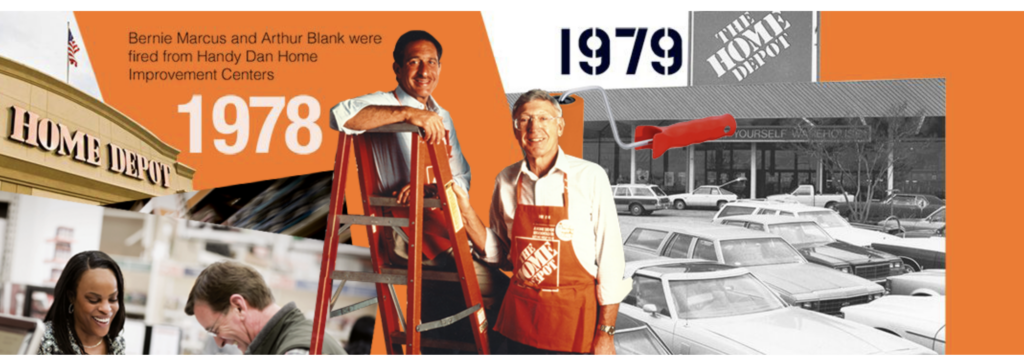
Two executives named Bernie Marcus and Arthur Blank opened two warehouse-style stores in Atlanta. They had been fired from Handy Dan Home Improvement Centers the year before.¹¹ Instead of looking for new jobs, they built something new.
They called it Home Depot.
Their first year, they averaged $81,700 in weekly sales across their stores.¹² By 1984, they had 19 stores and over $256 million in revenue.¹³ By 1989, they were the largest home improvement retailer in America.¹⁴
Home Depot didn’t win because they had better lumber.
Marketing strategies in the building materials industry must adapt to survive.
They won because they entered a consolidating market with a clear value proposition and aggressive visibility, while traditional dealers were still recovering from the recession.
They built “brand” when others cut brand and marketing efforts… And brand is the only true competitive moat.
Why I Keep Thinking About 1974
Todd Tomalak from Zonda told me something at the Window and Door Manufacturing Association conference in Boston that blew my mind.
“There have been more outlier, edge-case events in the last five years than in the prior 50 years combined.”
The building materials industry has evolved significantly over the decades.
The building materials industry faces new challenges today, much like it did in the past.
Pricing swings. Tariffs. Supply shortages. Labor chaos. Interest rate whiplash. Installer nightmares.
All those freak events. The kind that used to happen once in a generation. They happened multiple times in half a decade.
If that sounds familiar, it should.
We’re not in 1974 again. But we’re in something that rhymes with it.
What Todd’s Data Shows About What’s Coming
Todd’s research shows that home equity extraction is starting to rise. It’s been below 1% for years. When it moves, everything changes.
Homeowners tap equity. Projects get bigger. Budgets loosen. Remodeling leads the recovery.
His team expects 2026 to be remodel-led, with mid-single-digit growth picking up in Q2. By late 2026 into 2027, double-digit growth is possible.
Understanding customer needs is vital in the building materials industry.
That’s the setup.
Insights from the building materials industry can inform future strategies.
But here’s what most companies miss.
The winners in a recovery aren’t the ones who wait for the signal to be obvious. They’re the ones who positioned themselves during the downturn. The ones who stayed visible while competitors went dark. The ones who kept relationships warm when others pulled back.
Just like 1975.
The Mistake That Costs Market Share
Right now, most companies in the building industry are in defensive mode.
Trends in the building materials industry should guide decision-making processes.
Cutting marketing. Reducing headcount. Waiting for conditions to improve.
It feels responsible. It feels safe.
But the companies that gained share in 1975 and 1976 did something different. They kept their reps on the road. They showed up at dealer events when attendance was thin. They kept their name in front of contractors. When the market turned, they were the first call.
Here’s the uncomfortable truth about cutting visibility to save money:
The way buyers choose has fundamentally changed. They research before they call. They compare online before they walk into a showroom. AI tools are shaping early-stage decisions. A new generation of buyers and pros is entering the market with different expectations—they expect to find you easily, understand your value quickly, and feel confident choosing you before they ever speak to a human.
When you go dark, you don’t just lose awareness. You lose the ability to be found when it matters. And the companies that stayed visible during the downturn? They’re the ones AI tools will recommend. They’re the ones who show up in searches. They’re the ones the next generation of buyers will recognize.
Brand is not a line item to cut. Brand is how you get chosen when you’re not in the room.
What Winners Do When Markets Shift
The companies that come out of disruption stronger share a few things.
They get clearer about who they are and what they do. Uncertain markets reward clarity. When buyers are nervous, they choose what feels safe and obvious. If your positioning is muddy, you get skipped. If your value is clear, you get chosen.
They stay present when competitors disappear. Visibility during downturns is underpriced. Everyone else pulls back, which means the attention is easier to earn. The companies that keep showing up build trust that compounds when the market returns.
They protect relationships, not just transactions. When times are tight, relationships matter more. The dealers, contractors, and pros who trust you will stick with you. The ones who don’t know you will shop price. Relationships are a hedge against commoditization.
Challenges in the building materials industry include fluctuating prices and supply chain issues.
They move before the signal is obvious. By the time everyone agrees the market has turned, the best positioning is already taken. The winners are the ones who moved six months earlier.
Collaboration within the building materials industry fosters new ideas and solutions.
Emerging technologies are reshaping the building materials industry.
Many leaders in the building materials industry are focusing on sustainability and innovation.
Opportunities for growth in the building materials industry are emerging as the market evolves.
Your Move
Understanding the landscape of the building materials industry is essential for success.
If you’re waiting for the market to improve before you invest in visibility and positioning, you’re already behind.
The building materials industry is evolving with new market dynamics.
Get clear on your story. Can you explain in one sentence why someone should choose you? If not, fix that first.
Investing in technology is crucial for the building materials industry to thrive.
Stay visible where buyers look. Your competitors are cutting marketing. Show up consistently while they disappear. Remember: buyers now research before they call, and AI tools are shaping what they see.
Strengthen your channel relationships. Dealers and contractors remember who supported them during hard times. Be that company.
Prepare for remodel-led growth. Todd’s data shows remodeling will lead the recovery. If you’re not positioned for that, start now.
The Real Question
The building materials industry plays a crucial role in the economy.
The market will shift. It always does.
Will you be positioned when it happens?
The companies that got consolidated in 1975 weren’t bad companies. They were strong operators with good products and real expertise. They just went quiet at the wrong time. And when the market came back, buyers had already moved on.
Innovation is a key factor in the future of the building materials industry.
Home Depot didn’t emerge because the old guard failed. They emerged because the old guard was still recovering while Marcus and Blank were building something visible, aggressive, and impossible to ignore.
The next Home Depot is being built right now. Somewhere. By someone who sees this moment as opportunity, not obstacle.
Want the Full Conversation?
The building materials industry needs to adapt to changing consumer demands.
Todd and I went deep on market trends, the 1974 parallel, home equity extraction, and what’s coming in 2026. Watch the full episode on YouTube or listen on the Grit Blueprint Podcast.
Strategic decisions in the building materials industry can lead to lasting success.
Listen: https://www.buzzsprout.com/2335084/episodes/18389576
Join Built to Win
If you’re a leader in the building industry who wants to come out of this market stronger, Built to Win will show you how.
I write for owners, CEOs, and decision-makers who refuse to wait for permission to win.
Investors are keeping a close eye on the building materials industry as trends change.
P.S. The companies that got consolidated in 1975 weren’t bad companies. They were invisible companies. Don’t let that be you.
P.S.S. Home Depot opened its first stores four years after the lumber recession bottomed out. They didn’t wait for the market to recover. They built while others hesitated. That’s how category leaders are made.

Stefanie Couch, Founder, Grit Blueprint
FOOTNOTES
- ¹ TIME Magazine, “The Year That Building Stopped,” October 28, 1974. The article states housing starts ran at an annual rate of “almost 2.5 million” in January 1973.
- ² Federal Reserve History, “Oil Shock of 1973-74.” Oil prices rose from $2.90 per barrel before the embargo to $11.65 per barrel by January 1974.
- ³ Federal Reserve Bank of Kansas City, “Inflation in 1972: A Cautionary Tale.” CPI inflation reached its local peak of 12.3% in December 1974.
- ⁴ Federal Reserve Bank of Kansas City, ibid. The FOMC increased the federal funds rate to 10.8% by September 1973, with continued rate pressure through 1974.
- ⁵ Wikipedia, “1973-1974 Stock Market Crash.” The Dow Jones Industrial Average lost over 45% of its value between January 11, 1973 and December 6, 1974.
- ⁶ TIME Magazine, “The Year That Building Stopped,” October 28, 1974. Starts fell to “an annual rate of about 1.1 million, the lowest level in almost five years.”
- ⁷ TIME Magazine, October 28, 1974.
- ⁸ Construction Physics, “The Rise and Fall of the Manufactured Home, Part II,” July 2022. Mobile home shipments declined from 580,000 in 1973 to 213,000 in 1975—a 63% drop.
- ⁹ Construction Physics, ibid. “40% of mobile home manufacturers went out of business.”
- ¹⁰ LMC corporate history. Founded in 1935 during the Great Depression, LMC reached 120 stockholders by 1975 and crossed $100 million in purchases for the first time that year.
- ¹¹ The Home Depot corporate history; Wikipedia. Marcus and Blank were fired from Handy Dan in April 1978 and founded Home Depot the same year.
- ¹² Britannica Money, “The Home Depot: History, Growth & the DIY Revolution.” First-year average weekly sales reached $81,700.
- ¹³ Wikipedia, “Home Depot.” By 1984, Home Depot operated 19 stores with sales exceeding $256 million.
- ¹⁴ Britannica Money, ibid. Home Depot surpassed Lowe’s to become the largest home improvement retailer by 1989.